
Agentic AI vs Generative AI: What's the Difference and Which Does Your Business Need?
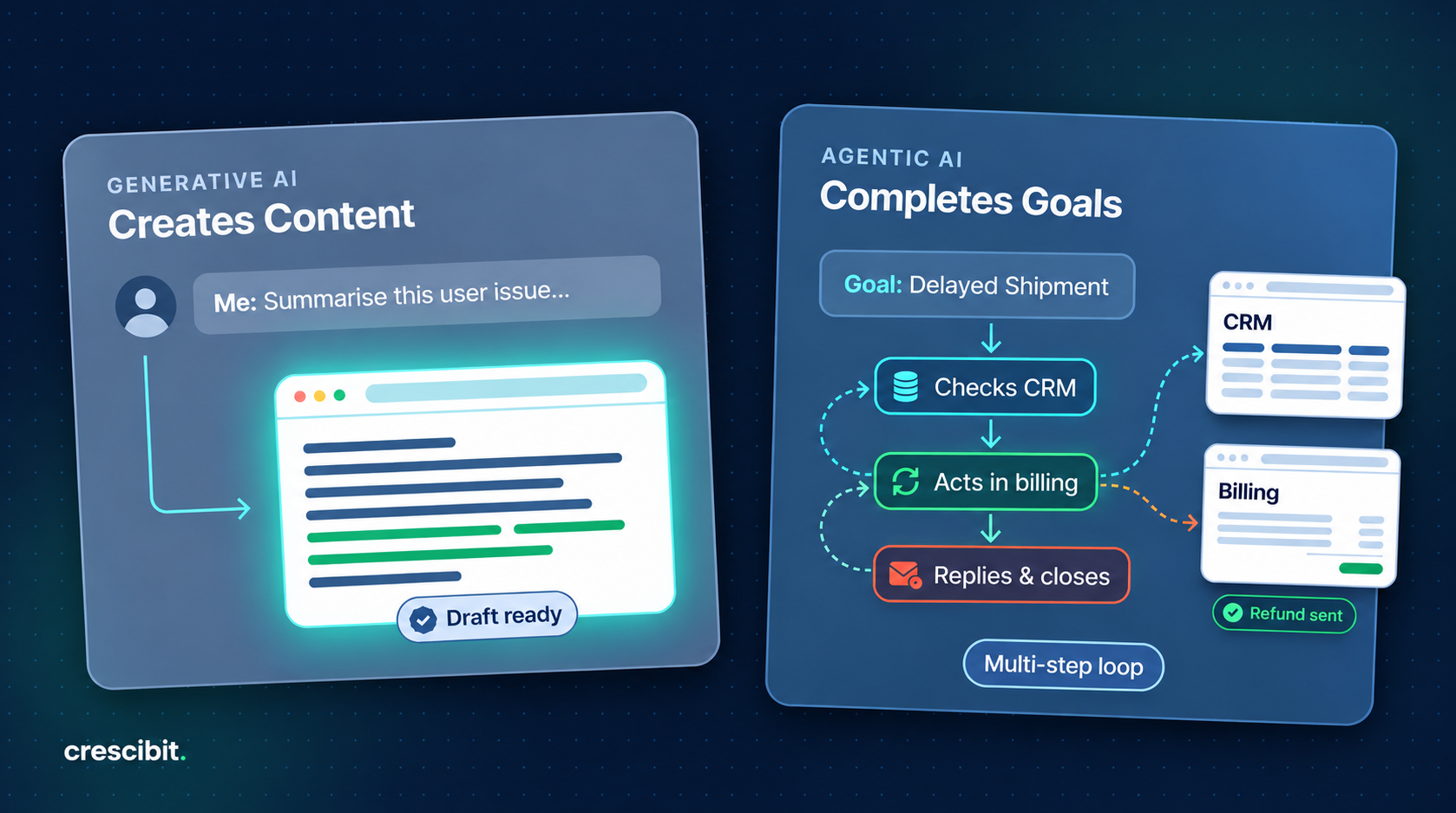
Writer or worker? The quick answer: Generative AI creates something for a person to read, edit or approve: a draft, a summary, an answer or a piece of code. Agentic AI takes a goal, connects to your business tools and completes multi-step work on its own within limits you set. When weighing agentic AI vs generative AI, the real question isn't which technology sounds newer; it's whether the job ends with a piece of content or with an action inside another system. Most products end up using both, and most businesses are better off starting with generative AI before handing software the keys to act.
Every vendor deck right now seems to promise "autonomous AI agents." If you're planning a product or modernising an internal workflow, it's easy to wonder whether a standard generative AI feature is already outdated, or whether paying for an agent is just burning budget on hype.
Here is the real difference between agentic AI and generative AI, what each one costs to build and run, and a simple way to tell which one your idea actually needs.
What is generative AI?
Generative AI is software that creates new content (text, images, code or audio) when a person prompts it.
It works in a single turn. You ask, it generates an answer based on patterns it learned during training, and it stops. Nothing happens next until a human reads that output and decides what to do with it.
In a business, that covers more ground than people give it credit for: drafting customer replies, summarising a 45-minute sales call, pulling key terms out of a contract, or letting your team search internal help docs in everyday language. Because a person sits between the output and the customer, a bad answer is an annoyance, not a crisis. Someone catches it before it goes out.
What is agentic AI?
Agentic AI is software that takes a goal, breaks it into steps, uses external tools and carries out the work on its own, while people set the rules and review the exceptions.
Instead of one prompt and one reply, an agent works in a loop. It reads the situation, picks the next step, acts inside an approved tool (your CRM, calendar, billing system or database), checks the result, and keeps going until the job is done or it hits a boundary where it has to ask a human.
One distinction worth keeping straight: agentic AI is the overall approach, while AI agents are the individual workers built inside it. When a company builds or buys something here, it's usually a single agent handling one narrow, well-defined workflow, not an all-knowing digital employee.
Working with an agent also changes your team's role. You're no longer prompting; you're managing. You define the goal, restrict what tools it can touch, cap what it's allowed to spend or change, and audit what it did.
Agentic AI vs gen AI: what is the difference in practice?
Generative AI answers and agentic AI acts. That single shift changes how you scope, test, secure and budget for the software.
Generative AI | Agentic AI | |
|---|---|---|
Core job | Produce content when asked | Complete a multi-step goal |
Trigger | A person typing a prompt | A person, a schedule or an event (like a new ticket or invoice) |
Systems it touches | A chat window or your knowledge base | Live tools: CRM, inbox, billing, ERP, database |
Who decides the next step | The person reading the output | The software, inside guardrails you set |
What a mistake looks like | A wrong or made-up paragraph someone can edit | A wrong action already taken, like an email sent, a record overwritten or a refund issued |
How you measure quality | "Is this output useful and accurate?" | "Did the workflow finish cleanly across messy real-world cases?" |
What you need to build | A model, strong prompts and clean source docs | Goals, tool permissions, business data, step memory, guardrails and an audit trail |
Build and testing effort | Lower | Significantly higher (integrations, edge-case testing, monitoring) |
Typical example | Drafting a reply to a delayed-order email | Checking the carrier API, updating the order record, issuing a capped credit and sending the reply |
Do agentic AI and generative AI work together?
Yes. Almost every useful agent relies on a generative model as one of its internal tools.
Picture a customer messaging about a missing delivery. The agent looks up the order in your database and checks the courier's tracking API. That's agentic work. It hands those facts to a generative model to write a clear, polite update. That's generative work. Then the agent sends the message, logs the interaction in your CRM, and flags an account manager if the order value crosses a threshold. Agentic again.
So the choice is rarely either/or. The practical decision is how much authority you give the software around the text it produces.
What do the two look like inside a working business?
Most departments end up using both: generative AI where judgement still belongs to a person, and agentic AI where clicking between tools is the real bottleneck.
Department | Generative AI handles | Agentic AI handles |
|---|---|---|
Customer support | Summarising long ticket threads, drafting replies for agents to review | Looking up order history, applying refund rules under a set limit, updating the ticket, escalating edge cases |
Sales | Writing tailored outreach emails and call recaps | Enriching a new lead, logging notes in the CRM, booking a follow-up slot once the prospect replies |
Finance | Turning a monthly P&L variance into a short executive brief | Matching vendor invoices against purchase orders, flagging discrepancies, queuing approved bills for sign-off |
HR & Recruiting | Writing job descriptions, answering employee handbook questions | Screening applications against fixed criteria, coordinating interview slots, sending reminders |
Operations | Summarising daily warehouse or logistics reports | Watching stock thresholds, raising draft purchase orders within budget, tracking supplier delivery dates |
Notice that the exact same task can sit on the generative side in one company and the agentic side in another. It comes down to how clean your underlying systems are, and how expensive a mistake would be.
How do you know which one your product idea needs?
Four questions settle almost every case before you spend a rupee or a dollar on development:
Where does the job end? If success is a draft, summary or answer a person reads, generative AI is enough. If value only shows up when another system changes, you're looking at an agent.
Can a human review every output? If yes, keep a human in the loop. It's faster to ship and far easier to trust. Only automate the action when volume makes manual clicking the main cost.
Are the steps fixed or messy? If the rules never change (for example, "when a form is submitted, create a CRM row and send a Slack alert"), standard workflow automation beats both. You don't need AI where an
if/elserule already works.Can a bad run be capped or undone? Agents belong on reversible or tightly bounded tasks first, never on irreversible actions without a human checkpoint.
Here is how those four questions play out across common product ideas:
Product idea | Best fit | Why |
|---|---|---|
Internal search assistant for company SOPs and docs | Generative | The job ends when an employee reads the answer |
Proposal or product-description generator | Generative | A person reviews and edits before anything goes live |
Analytics dashboard that answers questions in everyday language | Generative | It explains data; it doesn't modify records |
Support tool resolving routine returns up to a fixed limit | Agentic + generative | It acts in billing and ticketing, while generating the reply |
Automated invoice reconciliation and payment queuing | Agentic (with human sign-off) | Spans multiple systems, but money leaving the account needs a checkpoint |
Outbound lead research, CRM logging and meeting booking | Both | Drafting is generative; enriching, logging and booking are actions |
Appointment scheduling assistant | Agentic | The goal is a confirmed slot inside a live calendar |
A surprising share of project briefs that start with "we need an AI agent" turn out to be generative features, or simple API automation, once you walk through those four questions.
What does agentic AI require that generative AI doesn't?
Giving software permission to act introduces engineering and governance work that a simple prompt-and-response feature never has to deal with:
Scoped permissions. Explicit rules on which systems the agent can touch, which actions it can take, and hard caps (like maximum refund amounts or daily send limits).
Human-in-the-loop checkpoints. Mandatory pause points before anything irreversible, financial or high-stakes goes through.
Scenario-based testing. You're no longer checking whether a paragraph reads well. You're testing how the agent behaves across dozens of messy, incomplete or contradictory inputs, and making sure it stops when it's unsure.
Audit trails and rollbacks. Every tool call logged, traceable and reversible where possible.
Clear ownership. A named person on your team who monitors failures and owns the guardrails.
This is where most agent projects stall. In its July 2026 review of enterprise rollouts, Forbes echoed Gartner's warning: teams hand agents system access before defining ownership, guardrails and rollback controls, and pull the plug once the first costly mistake happens.
Does agentic AI cost more to build and run?
Yes, both upfront and every month after launch.
Upfront, you're paying for API integrations, permission layers, failure handling and far heavier QA than a generative feature requires. Ongoing costs also scale differently. A generative feature usually makes one model call per user request, whereas an agent often runs 5 to 15+ model and tool calls in a loop for a single task, plus retries when an external API hiccups, and logging and monitoring infrastructure to watch every run.
Exact numbers depend on task volume, model choice and how many systems are connected. Any agency quoting a flat number before mapping your tool calls and volume is guessing.
Why are so many "agentic" tools just rebranded chatbots?
Because "agent washing" is everywhere right now: vendors relabelling basic chatbots, search wrappers and rule-based workflows as autonomous agents to charge a premium.
In Gartner's June 2025 analysis, analysts estimated that out of thousands of vendors claiming agentic capabilities, only about 130 offered genuine ones. Gartner also projected that over 40% of agentic AI projects will be cancelled by the end of 2027 due to rising costs, unclear business value and weak risk controls, even while predicting that 33% of enterprise software applications will include agentic capabilities by 2028 (up from under 1% in 2024).
The technology is real; a lot of the sales pitches aren't. If an agency or SaaS vendor pitches you an "agentic" solution, ask four blunt questions before signing anything:
Question to ask | A good answer sounds like | A worrying answer sounds like |
|---|---|---|
What exact actions does it take on its own? | "It reads the ticket, checks order status via Shopify's API, and issues refunds under $50." | "It autonomously handles your entire customer support workflow." |
What happens when it's unsure or hits an edge case? | "It stops, logs the state and routes the ticket to a human with a summary." | "The model is smart enough to figure it out." |
How do we cap risk or undo a bad action? | "Scoped API keys, hard dollar limits, full action logs and approval gates on high-value steps." | "We'll add guardrails after we launch the first version." |
Could this be built cheaper without an agent? | "Honestly, for step one, a generative draft plus a simple webhook gets you 80% of the value." | "Everything should be agentic now so you're future-proof." |
Where should a business start?
Start with generative AI on one contained workflow, measure whether it actually saves time or improves quality, and add autonomy one capped step at a time.
AWS's SMB guide recommends the same progression. In practice, it looks like a four-rung ladder:
Stage | What the software does | What your team does | Smart first use case |
|---|---|---|---|
1. Draft | Writes, summarises or extracts | Reads, edits and sends | Support replies, call notes, invoice extraction |
2. Suggest | Proposes the next action with reasoning | Approves or rejects each one | Suggested refund amount, suggested CRM update |
3. Act with approval | Executes the workflow, pauses at risky steps | Signs off at checkpoints | Invoice matching with human payment sign-off |
4. Act within limits | Completes routine, low-risk cases end-to-end | Audits samples and handles exceptions | Low-value refunds, standard appointment rescheduling |
Only move up a rung once the one below it has a track record you trust. Skipping straight from zero to Stage 4 is how teams end up in Gartner's 40% cancellation column.
What does it take to build either one into your product?
Whether you start at Stage 1 or Stage 3, a reliable build comes down to four pieces:
A narrow, measurable task. Written down before code starts. Not "add AI to our app," but "cut first-response drafting time on Tier-1 tickets by half."
Clean data access. Knowing which documents, databases or APIs the model needs, and stripping out sensitive data it has no business seeing.
Scoped integrations. One or two connections for a generative feature; tightly permissioned API access to every system an agent touches.
Evaluation and monitoring. A real test set of messy edge cases before launch, plus logging and alerts once real users hit it.
What should you do next?
Still exploring where AI fits in your roadmap? Read our 2026 software development trends to see how AI features sit alongside security, privacy rules and build costs.
Have a product idea and not sure whether it needs generative AI, an agent or plain automation? Book a free consultation to talk it through before committing to a build.
Ready to scope an AI feature or prototype? Take a look at our custom AI solutions and consulting page.