
How to Hire a Dedicated Development Team: 12 Questions to Ask Before You Sign Anything
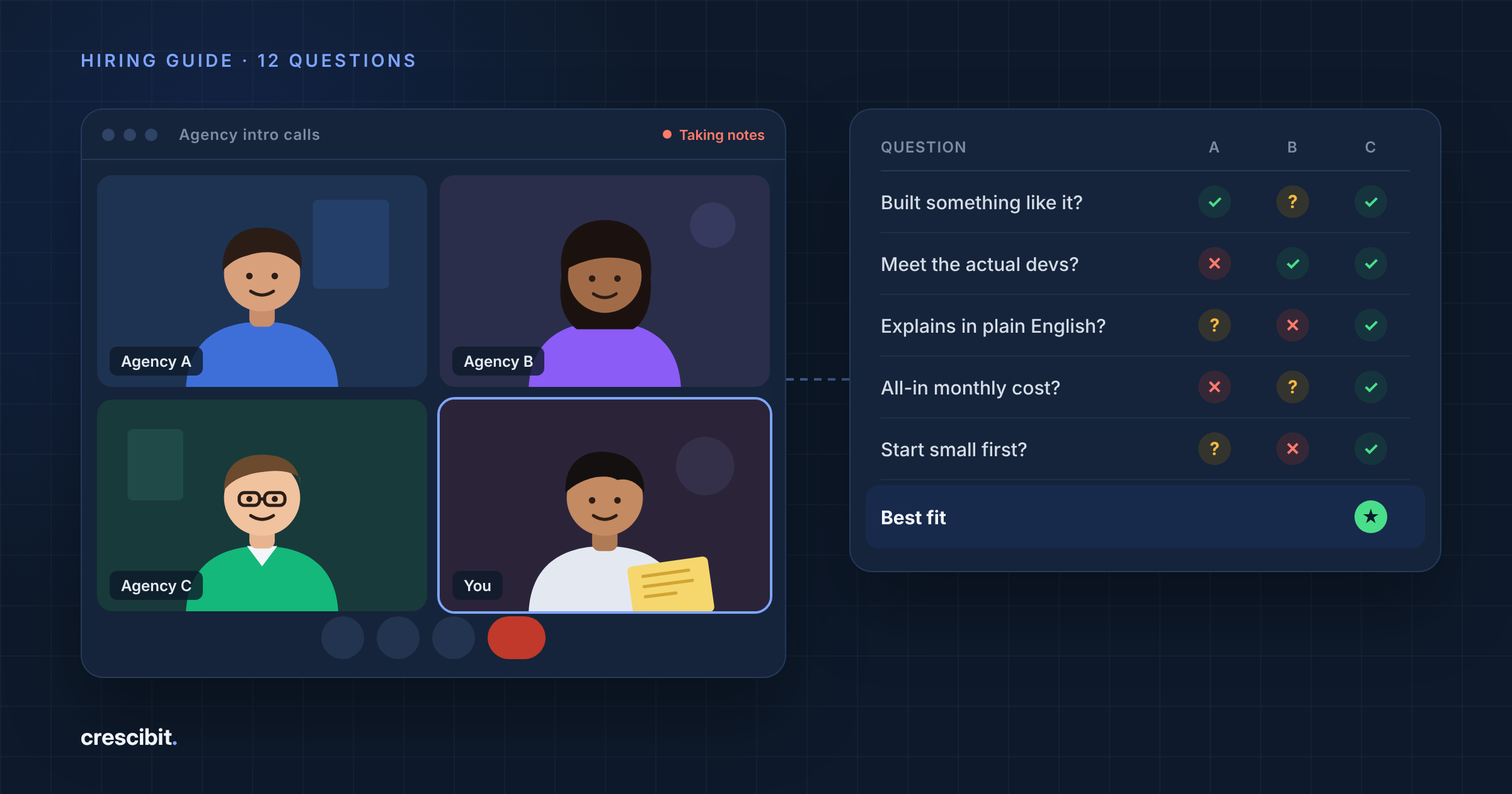
Short answer: Before you hire a dedicated software development team, ask questions that test three things: whether they fit your product, whether they will guide you honestly when you are not technical, and what the engagement will really cost. The 12 questions below cover all three. Ask every agency the same 12 questions and keep a mental scorecard as you go. After two or three calls, the best fit usually stands out on its own.
If you are reading this, you probably have an idea, a budget, and a shortlist of agencies that all sound the same on their websites. Senior engineers. Agile. Transparent. Flexible.
The hard part isn't finding an agency. It's telling them apart before you spend money, especially if you don't have a technical co-founder to sit in on the calls. These questions are written for exactly that situation: you don't need to understand the code to understand the answers.
What is a dedicated development team?
A dedicated development team is a group of developers who work only on your product, full time, usually through an agency that employs them and bills you monthly. You decide what they build; the agency handles hiring, salaries, equipment and replacements. It sits between hiring freelancers (cheaper, less stable) and hiring in-house (most control, slowest and most expensive to set up).
Questions about fit: are they right for my product?
1. Have you built something like my product before?
This is the fastest filter on the list. A team that has built a similar product already knows the expensive mistakes in your industry.
Listen for: two or three specific past projects with the same kind of users, integrations or compliance rules as yours, and what they learned from them. A good agency will tell you what went wrong on those projects and what they would do differently, not just show you polished screenshots. That experience is what saves you from paying for the same mistakes twice.
Walk away if: every answer is "we can build anything".
2. Is a dedicated team actually right for me, or would freelancers or a fixed project suit me better?
An honest agency will sometimes talk you out of hiring them. If your scope is small and clearly defined, a fixed-price project or a single freelancer may be the better deal.
Listen for: questions about your timeline, budget and how much the product is likely to change, followed by a clear recommendation, even if it isn't their most profitable one. An agency that says "a dedicated team is more than you need right now; start with a fixed project" is putting your outcome ahead of the contract. That's the kind of partner you want when bigger decisions come later.
Walk away if: the answer is "dedicated" before they have asked you anything.
3. Can I speak to a client who has worked with you for more than six months?
Case studies show the best project. A long-term client tells you what the agency is like on an ordinary Tuesday.
Listen for: a name and an introduction, ideally a client in your country and at a similar stage to you. When you speak to them, ask how the agency handled a missed deadline or a disagreement, because every project has one. An agency that connects you without hesitation is confident their long-term clients will speak well of them.
Walk away if: they can only offer written testimonials, or every reference is a client who finished months ago.
4. Who exactly would work on my product, and can I meet them before I decide?
Some agencies pitch with their best people and staff the project with whoever is free.
Listen for: named profiles you can interview, with experience on products like yours, and a clear yes to meeting them before you sign. A short call tells you whether they communicate clearly and ask sensible questions about your business, not just about code. These are the people you'll trust with your budget every month, so you should choose them, not inherit them.
Walk away if: "we'll assign the right people after you sign".
Questions about guidance: will they help me decide, or just take orders?
5. What do you need from me to get started? I don't have a detailed spec.
Most founders don't. A spec, often called a software requirements specification (SRS), is the document that describes what your product should do: who the users are, what features and screens it needs, how each one should behave, which other tools or systems it connects to, and rules around things like security and speed. Developers use it to estimate cost and time, and it becomes the shared reference for what "finished" means. Writing a good one takes product and technical experience, which is exactly what most first-time founders don't have yet. A good partner treats that as normal and helps you get from an idea to a clear plan.
Listen for: a short, structured way of capturing your requirements together, such as a few discovery calls, simple user flows and a written scope, instead of asking you to arrive with a 40-page document. A good partner turns your idea into a plan with you, asking about your users and goals before talking about features. If they can describe this first step clearly, you won't be left guessing at the start.
How we do it at Crescibit: we don't ask for a finished document. We ask you to show us what you mean: screenshots from apps you like, a rough sketch (even one scribbled in Paint), or a reference video. We also suggest you talk it through with everyone who has a stake in the product first, so nothing important comes up late. If it helps, we share a sample spec so you can see what the end result looks like, then we build yours together.
Walk away if: they send you a quote with a very basic specification.
6. Can you explain one technical decision you would make for my product, in plain English?
This question tests whether you'll be able to work with them when you don't understand the jargon.
Listen for: an answer you understand the first time, with the trade-off spelled out, for example "this costs a little more now but saves you a rebuild when you pass 10,000 users." Good teams translate technical choices into money, time and risk, because that's what you're actually deciding on. If they can do it on a sales call, they'll do it when a real decision lands on your desk.
Walk away if: you leave the call more confused than you started.
7. Should I build for web, mobile or both first, and why?
There is no universal right answer, which is what makes it a good test. The reasoning matters more than the recommendation.
Listen for: questions about who your users are, where they'll use the product and how they'll find it, followed by a recommendation tied to your budget and launch date. There's no single right answer here, so the reasoning matters more than the choice. An agency that explains the why will also tell you when it's time to add the second platform.
Walk away if: they recommend both at once without asking about your budget, or always push the platform they happen to specialize in.
8. Do you handle design as well, or will I need a separate design agency?
Splitting design and development across two companies adds hand-offs, and someone has to manage them, often you.
Listen for: a clear answer on who designs, who approves the designs, and how those designs reach the developers without getting lost along the way. Ideally designers and developers work in the same team, so what you approve is what gets built. If two companies are involved, find out who is responsible when a finished screen doesn't match the design.
Walk away if: design is "handled by a partner" they can't name, or nobody can show you designs and the finished app side by side.
9. What is one thing you've advised a client not to build?
You are looking for a trusted guide, not an order-taker. Agencies that have never pushed back on a client will not push back on you either.
Listen for: a real example, told without embarrassment, of a feature or idea they talked a client out of, and why. It shows they will spend your money as carefully as their own. An agency that has never said no to a client will build whatever you ask, including the expensive mistakes.
Walk away if: they can't think of a single example, or say "the client is always right".
Questions about money: what will this really cost me?
10. What is the all-in monthly cost, and what is not included?
The rate on the proposal is rarely the whole bill.
Listen for: The monthly cost includes multiple cost components, such as development, project management, QA, tools and licenses, hosting, third-party services, and app store fees. Every agency packages these differently, so ask them to spell out in writing which of these are included and which are billed as extras. Clear pricing up front means no surprises on your first invoice, and it makes comparing agencies side by side far easier.
Walk away if: they only give an hourly rate, or the extras list stays vague until after you sign.
11. Can we start small before committing long term?
You shouldn't have to bet your whole budget on a sales call.
Listen for: a paid trial period or a short, fixed discovery phase, so you can judge the quality of the work before signing a long engagement. A few weeks of real work tells you more than any sales call or portfolio. Agencies that are confident in their team are usually happy to start small.
Walk away if: the only option is a 6 or 12-month commitment from day one.
12. What will my first year cost, not just my first month?
Monthly rates hide the real number. Hosting, third-party services, app store fees and post-launch support all add up.
Listen for: a rough 12-month estimate with the main cost lines, such as the team, hosting, third-party services and support after launch, and honesty about which numbers are still uncertain. That's what you'll actually be budgeting for, not just the first invoice. An agency that helps you see the full year is helping you plan, not just selling to you.
Walk away if: they won't estimate beyond the monthly rate, or every extra cost is "we'll see".
How do I compare dedicated development agencies?
If you're not technical, this is the simplest way to choose a software development company. Score each agency from 0 to 2 on every question (0 = vague, 1 = acceptable, 2 = specific and willing to put it in writing). A total under 16 out of 24 deserves a second look. A 0 on question 1, 2 or 9 usually means the agency sells capacity, not judgement.
Question | Agency A | Agency B | Agency C |
|---|---|---|---|
1. Built something like it before | |||
2. Honest about whether I need them | |||
3. Long-term client reference | |||
4. Meet the actual developers | |||
5. Getting started without a spec | |||
6. Explains in plain English | |||
7. Web vs mobile reasoning | |||
8. Design in-house or separate | |||
9. Something they advised against | |||
10. All-in monthly cost | |||
11. Start small option | |||
12. First-year cost | |||
Total (out of 24) |
Tip: copy this table into a spreadsheet and fill it in during your calls.
What should you do next?
That depends on where you are in your search:
Still comparing agencies? Ask us for Crescibit's written answers to all 12 questions, so you can put them next to every other agency's answers. Get our answers →
Ready to talk? Book a free 30-minute consult and ask us every question live. Book a free consult →
Already chosen a team? Picking the right team is half the job; starting well is the other half. Read 6 mistakes founders make when they hire a dedicated software development team before you begin.